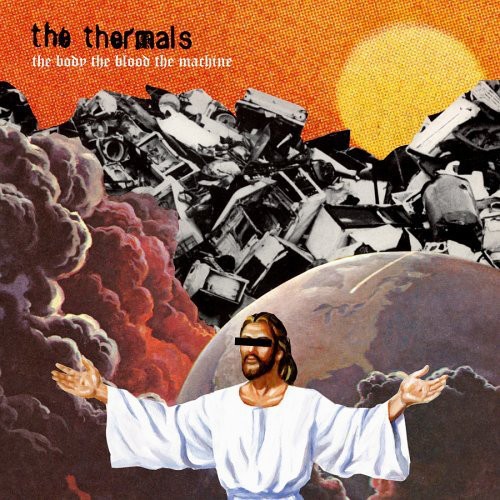
The decisive sound on The Body, the Blood, the Machine is the brightness of its forward motion. The guitars do not loom or grind. They chime and scrape in a narrow, hard band, pushed high enough in the mix to feel exposed rather than heavy. The drums mostly refuse theatrical menace. They get on with it. Hutch Harris sings as if he has no time to make dread ornate, his voice pitched between sermon, report and playground taunt. On “Here’s Your Future”, the apocalypse comes in at a sprint, the hook arriving before the horror has fully settled into the room.
That is the album’s governing move: catastrophe delivered at the tempo of something you already know how to sing. The question is what this propulsion is for. Punk speed can flatter urgency, turning a political warning into a raised fist with a good backbeat. The Thermals do something colder and more interesting. They use velocity to make doctrine sound normal, almost domestic. The music keeps insisting that tyranny does not always announce itself with drums of doom. Sometimes it comes with a chorus you learn on the second pass.
The album’s title gives away its theology of machinery, but the record itself is leaner and less grand than that phrase suggests. These songs are short, clipped, bright, full of unvarnished melodic shapes. They run on the pop-punk principle that the ear should never be left waiting too long for a return. Verse, lift, chorus, repeat. The danger is not buried in the arrangement. It is carried by it.
What makes the record more than a set of slogans is the way its economy shrinks large systems of power to the size of ordinary musical habit. “Here’s Your Future” begins with biblical scale, God’s hand reaching down, the flood myth repurposed into a political origin story. Yet the track does not swell to match the myth. It snaps into a bright, compact progression, and Harris sings the revelation with unnerving plainness. The arrangement refuses awe. The old story has become a jingle, which is precisely the point.
The Thermals’ great formal trick here is to let repetition stand in for indoctrination without making the songs feel like lectures about indoctrination. “I Might Need You to Kill” is built around a command so blunt it risks parody, but the band sets it into a tune that is almost companionable. The phrase returns with the matter-of-fact pressure of a family instruction, something passed across a kitchen table rather than shouted from a podium. The guitar does not darken around it. The rhythm does not pause to underline the obscenity. The instruction becomes terrifying because the song makes room for it as if it belongs there.
This is where the album’s pop craft does its political thinking. The choruses do not merely summarise the verses. They normalise them. In “An Ear for Baby”, the clipped momentum and chant-like vocal line turn surveillance and obedience into nursery-rhyme architecture. “A Pillar of Salt” has one of the record’s cleanest surges, a chorus that seems to lift the body before the mind has finished objecting to the circumstances. The old punk pleasure of acceleration becomes morally unstable. You are carried by the same mechanism that the song is accusing.
The production matters because it declines both murk and grandeur. A heavier record might have made authority sound monstrous, external, easy to identify. A more artful one might have built a cathedral of dread around the concept. The Body, the Blood, the Machine stays dry and close. The bass is functional and driving, the guitar is serrated but not cavernous, the drums keep the songs upright. There is little interest in atmosphere for its own sake. The dryness gives the lyrics less cover, but it also makes the world of the album feel inhabited rather than staged. These are songs about systems entering the bloodstream through ritual, family, language, duty. Accordingly, the hooks do the entering.
“Returning to the Fold” is especially sharp on this point. Its title suggests both religious obedience and a social homecoming, and the band treats that ambiguity as an arrangement problem. The track moves with the brisk, elastic confidence of a song about rejoining something, even as the implied bargain is grim. The energy is not an escape from coercion. It is the sound of coercion made usable, made communal, made singable at volume.
There is a temptation, with a record this formally direct, to treat every feeling as the product of a visible device. Bright guitar plus frantic tempo equals exhilaration. Plain vocal plus violent lyric equals irony. Repeated hook plus theological language equals ideology reproduced by melody. Much of that is true, and still it does not quite account for why the best songs hit as hard as they do.
“A Pillar of Salt” works partly because of its momentum, partly because its chorus clears space without slowing down, and partly because Harris’s voice seems to find a seam of fear inside its own thinness. He is not a grand singer, which is a blessing here. There is no operatic suffering to admire from a distance. When he pushes upward, the strain sounds human-sized. The song’s terror is not only conceptual, not only an allegory of flight under theocratic power. It is in the way the melody keeps choosing movement over reflection, as if stopping would be fatal. Analysis can name that choice. It cannot quite reproduce the panic it creates.
The album is less convincing when its scheme is too legible. “Power Doesn’t Run on Nothing” is one of its most explicit statements, and the title alone carries a good deal of weight. The song’s force comes from its refusal to separate empire from appetite, but its plainness can feel like a diagram filled in with thick marker. The band still drives hard, and the chorus still bites, yet the mechanics here draw attention to the argument rather than releasing it. You can hear the thesis working. For a critic of arrangement, that should be satisfying. It is not always enough.
Tenderness enters the record obliquely, often through exhaustion rather than softness. “St. Rosa and the Swallows” loosens the grip slightly, letting the melody feel less like a command and more like a memory of shelter. “Back to the Sea” shifts the album’s pressure towards flight, with the band’s usual propulsion taking on a more desperate contour. The sound does not become gentle, exactly, but it begins to suggest that survival has its own rhythm, one that resembles escape less than stubborn continuation.
The record’s emotional range is narrower than its narrative reach. That narrowness is part of its strength, and part of its limitation. It can make fear, obedience and resistance feel inseparable because the same musical engine serves all three. It can also flatten grief into forward motion. By the time “I Hold the Sound” arrives, the persistence itself has become moving, although I am not sure the arrangement fully explains why. The song holds because it holds. Sometimes the most honest account of a mechanism is an admission that the machine has exceeded the diagram.
The album is often remembered as a political warning from the mid-2000s, and the framing is understandable. Its fusion of Christian imagery, authoritarian command and American violence was hardly subtle on release, and it has not become less legible with time. The danger in that reading is that it can reduce the record to a period document, a sharp pamphlet with distortion pedals. That undersells both its craft and its discomfort.

The Thermals were not making a broad survey of political disillusionment. They were writing a compact parable, and then refusing to score it like one. That refusal is crucial. The album’s authority figures do not require gothic effects. They live inside the syntax of pop-punk: the repeated line, the forced return, the communal shout, the momentum that makes consent feel like participation. Heard this way, the record’s politics are less a matter of topical reference than of form. It asks how quickly a phrase becomes natural once a song has taught your body when to expect it.
This is why the received “protest album” label is both useful and insufficient. Protest often imagines a voice standing outside power, naming it, condemning it, rallying others against it. The Body, the Blood, the Machine is stranger than that. Its voice is frequently inside the language it fears, borrowing the cadences of command and scripture, then setting them to music that rewards repetition. The listener is not allowed the clean comfort of agreement from a safe distance. The hooks implicate before they persuade.
The record also complicates the usual romance of punk directness. Speed here is not automatically liberation. Directness is not automatically truth. A simple chorus can be a weapon, a refuge, a trap, or all three in the space of ninety seconds. The Thermals understand that pop does not need complexity to become dangerous. It needs recurrence, pressure and a tune that survives first contact.
What propulsion makes possible
So what is the speed for? It is not only there to dramatise running, fighting or refusing, though it does all of that. It makes ideology audible as routine. It shows how belief acquires force by becoming repeatable, how command disguises itself as familiarity, how a chorus can feel like community even when the words point towards submission.
The album’s finest achievement is that it never has to choose between immediacy and pressure. Its songs are efficient in the old punk sense, but their efficiency is also their argument. They waste no time because systems of authority waste no time either. They move through the household, the congregation, the body, the song. The Thermals meet that movement with music bright enough to attract and hard enough to bruise.
A blunter protest record might have made the villains larger and the listener more righteous. The Body, the Blood, the Machine does something less comforting. It makes the machinery attractive. It lets you feel the pleasure of the form and then asks what else has entered with it. The result remains bracing because its warnings are built into the same parts that make the album fun: the crisp downstroke, the shouted return, the melody that will not leave. Authority, in these songs, does not arrive as an interruption. It arrives on the beat.