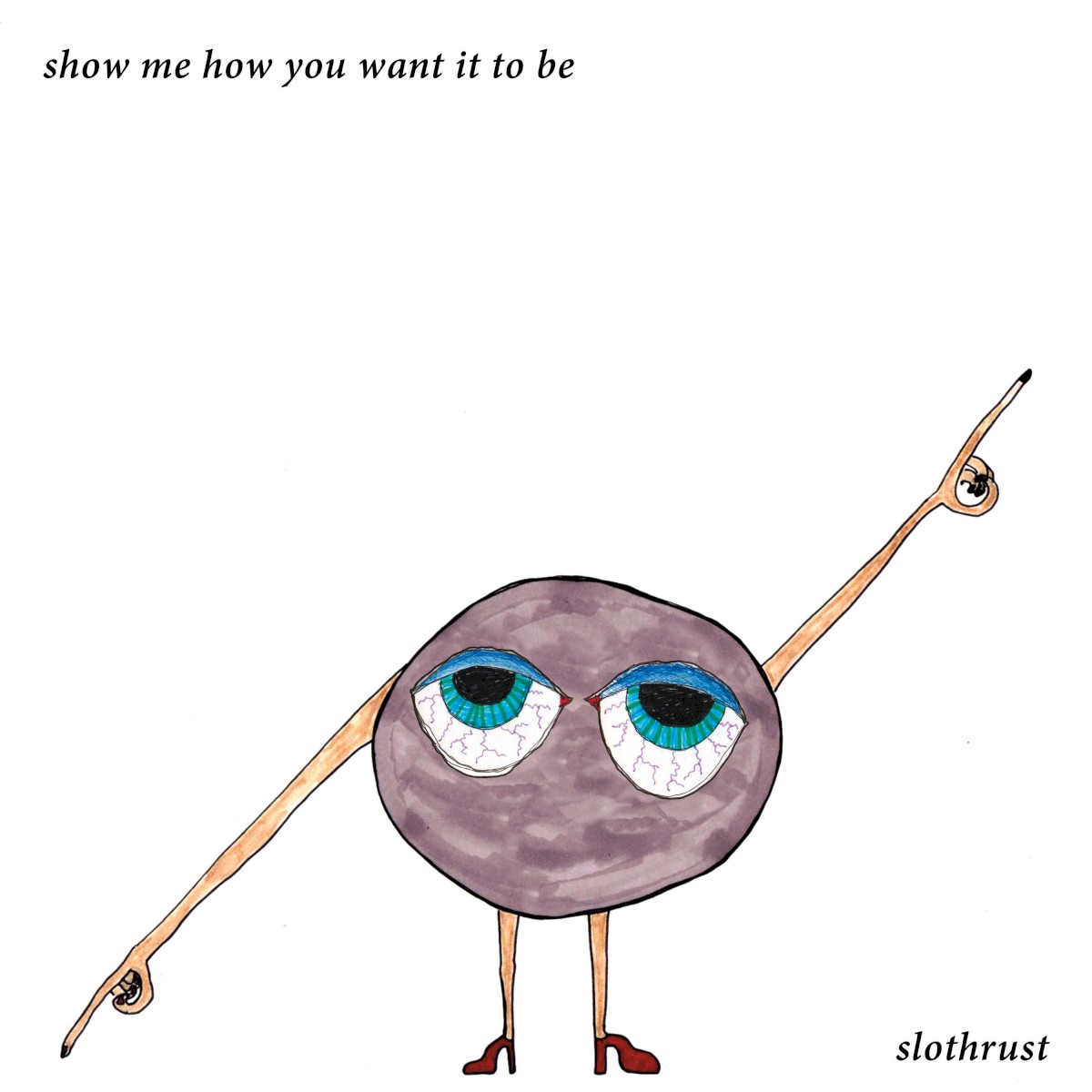
The easiest story about Show Me How You Want It To Be is that Slothrust have used the covers-record format as a trapdoor: fall through Britney Spears, Marcy Playground, the Turtles and The Wizard of Oz, and land somewhere newly legible. A guitar band taking on “…Baby One More Time” still pings the internet’s old novelty receptors, the same ones that used to turn every unlikely cover into a shareable proof of hidden depth. The algorithm loves a familiar title in unfamiliar clothes. So do critics, when we are not watching ourselves closely enough.
The question is whether that framing changes the music, or only changes the way the music is introduced to us. On that count, Show Me How You Want It To Be does not materially reset Slothrust’s sound. It sharpens the outline around what was already there: the band’s taste for slackened tempos, sour guitar pressure, vocal deadpan, sudden surges of feeling that refuse to announce themselves as catharsis. The borrowed songs make those traits easier to isolate, because the melodies arrive pre-loaded in the listener’s memory. They do not, on the evidence of the record itself, amount to a new set of terms.
That is not a dismissal. A covers album can be a diagnostic tool, and this one is most interesting when treated that way. It tells us less about Slothrust being reborn than about how durable their existing method is when applied to songs that have already survived other cultural weather systems: teen-pop spectacle, 90s alt-radio indolence, golden-age pop optimism, Hollywood fantasy. The frame has changed. The machine inside it keeps doing recognisably Slothrust things.
The record’s operating principle is subtraction first, abrasion second. Slothrust tend to begin by draining away the social memory of a song, the gloss of where we first encountered it, then reintroduce force through guitar tone, tempo and vocal proximity. On “…Baby One More Time”, the famous hook is not treated as a camp object or a guilty pleasure, two categories that should have been retired with low-rise jeans and smug blog culture. It is sung as a sentence with consequences. The line “show me how you want it to be”, which gives the album its title, sounds less like pop choreography than a request made from a room with bad lighting.
What matters musically is that the song’s architecture remains intact. The chorus still knows exactly where it is going. Slothrust do not dismantle it so much as change the pressure around it. The vocal sits close and comparatively dry, resisting the athletic polish associated with the original. The guitar does the expressive heavy lifting, worrying at the edges of the melody, pulling the song towards grunge without pretending the underlying pop machinery has vanished. The result is effective because the band trust the tune. They do not need to prove that Britney Spears had a real song under the production. The song already proved that by lodging itself in everyone’s nervous system for decades.
“Sex and Candy” is the more obvious fit, and therefore the less revelatory one. Marcy Playground’s original already moved with a narcotised shrug, all stale air and horizontal cool. Slothrust’s version leans into that lassitude rather than overturning it. The vocal delivery finds the blankness inside the lyric, while the guitar thickens the room until the song’s come-on starts to sound less seductive than trapped. But the transformation is mainly tonal. The song was always compatible with Slothrust’s language, which makes the cover satisfying in the way a well-cut jacket is satisfying: the fit is the point, not the surprise.
“Happy Together” gives the album a better test. Its source material depends on buoyancy, on the slightly uncanny insistence that romantic fantasy can be made true by melodic repetition. Slothrust hear the mania in that insistence. They slow the smile down until the teeth show. Again, though, the change is not chiefly structural. The familiar harmonic movement remains, the chorus still blooms, but the arrangement places a bruise beneath the brightness. The band’s gift here is not reinvention. It is emphasis, the ability to tilt a song a few degrees and let a different shadow fall across it.
“Somewhere Over the Rainbow” is the record’s most delicate risk, because it leaves the least room for ironic distance. You cannot out-weird that melody by grimacing at it. Slothrust’s handling of it is telling: the band avoid turning reverence into syrup, but they also do not vandalise the song for credibility points. The performance works when it accepts stillness. The vocal presence becomes central, not because it is technically showy, but because it lets the melody hang in the air without too much explanatory noise around it. When the guitar enters more forcefully, it feels like weather gathering rather than a mandatory rock conversion.
Across the album, the production favours legible instruments and a close vocal plane. There is polish here, but not the kind that sands off friction. The drums and guitars have enough space to make the dynamic shifts count. Slothrust’s loudness has never been interesting simply because it is loud. It works when it arrives as a change in emotional temperature, and Show Me How You Want It To Be understands that. The pacing is compact, which suits the project. Covers can become lectures very quickly. These songs mostly get in, make their argument, and leave before the seminar questions start.
Where the alteration is real, and where it is costume
The real modification happens in the band’s relationship to melody. Because these songs are already famous for their top lines, Slothrust cannot rely as heavily on the off-centre lyrical and melodic feints that animate their own writing. The record pushes the vocal into clearer shapes. It asks the arrangements to support songs that listeners may know backwards, which means any deviation is immediately audible. That constraint gives the album its tension. Slothrust sound slightly more disciplined here, not in the bogus “maturity” sense, but because the material refuses to disappear into vibe.
That is a structural shift, but a limited one. The songs move on established rails. Verse, chorus, release: the inherited forms hold. Slothrust’s interventions happen in weight, grain and angle. A tempo slackens. A guitar line scuffs the surface. A vocal phrase lands flatter than expected, making a lyric feel suddenly less innocent. These are meaningful choices, yet they do not constitute a wholesale change in the band’s musical logic.
The cosmetic changes are easier to overstate because they are easier to describe. A pop song becomes darker. A bright old standard becomes uneasy. A slacker-rock hit becomes heavier. This is where the surrounding story can start doing too much of the work. The distance between source and cover looks dramatic in a playlist thumbnail, especially when the source is a monument of mainstream pop. Heard as music rather than as metadata, the gap narrows. Slothrust are not revealing that these songs were secretly theirs all along. They are showing that their own grammar can survive contact with material that was never designed for it.
There are moments when that grammar feels too settled. The method can become predictable: lower the light, thicken the guitar, sing against the sentiment, wait for the emotional double exposure to appear. When it works, the song seems to acquire a second pulse. When it does not, the arrangement tells us what to feel before the performance has earned it. That is the risk of any strong interpretative signature. It can turn into a filter.
A catalogue entry, not a corrective
Placed beside Slothrust’s own records, Show Me How You Want It To Be is best understood as an angled mirror rather than a new chapter heading. The band have long worked the seam between looseness and precision: conversational vocals set against muscular playing, wry or estranged language giving way to guitar passages that say the unsayable by refusing to be tidy about it. Their songs often feel as if they are deciding, in real time, whether to make a joke, pick a fight or admit the wound. That instability is part of their charge.
The covers record preserves the sonic side of that equation while removing some of the lyrical oddity that makes the original material feel less easily classifiable. That absence matters. On a Slothrust song, a strange line can redirect the whole emotional field. Here, the words are already public property. The band can reinterpret them, stress different syllables, change their temperature, but they cannot make them newly strange in quite the same way. The trade-off is clarity. We hear the arrangements with fewer distractions. We also hear how much of Slothrust’s identity usually depends on the friction between their playing and their own peculiar language.
So no, this is not the moment where the band “become pop”, whatever that is supposed to mean in a world where most listeners encounter Nirvana, Britney and a 1939 film song through the same search bar. It is also not a retreat into rock authenticity, thank God. Slothrust’s handling of “…Baby One More Time” is strongest precisely because it refuses the old hierarchy that would make a distorted guitar version more truthful than the original by default. The cover is an interpretation, not a rescue mission.
Nor does the album need to be drafted into a story of growth, return or revival. Those arcs are often just tidy filing systems imposed after the fact. What can be heard here is more modest and more useful: a band testing its established habits against songs with unusually fixed public identities. Sometimes the songs bend. Sometimes the habits show. Both outcomes tell us something.
Show Me How You Want It To Be succeeds as a frame shift. It makes Slothrust’s strengths newly legible by placing them against material the listener may think they already understand. The best performances do not rely on the cheap thrill of mismatch. They find pressure points inside the songs and apply force with enough restraint to avoid flattening them. “…Baby One More Time” becomes a study in need without surrendering its pop clarity. “Happy Together” reveals the desperation inside its brightness. “Somewhere Over the Rainbow” is allowed to be vulnerable without being embalmed.
But the album does not reset Slothrust’s terms. Its core musical logic remains intact: close vocal presence, controlled abrasion, dynamic release, an instinct for making familiar structures feel slightly unstable. The covers format changes how we hear those qualities because it removes the burden of discovering the song and lets us focus on the handling. That is a real effect, but it belongs partly to the story around the record: the recognisable titles, the genre-crossing tease, the little dopamine flare of seeing a band you file in one mental drawer reach into another.
The record’s place in Slothrust’s body of work is therefore neither major rupture nor disposable aside. It is a useful, sometimes sharp, occasionally over-familiar demonstration of method. If you come to it looking for reinvention, you may mistake the lighting for the architecture. Listen past the premise and the more interesting verdict appears: Slothrust have not changed the house. They have opened the curtains in a different room.