Boards of Canada have long been understood as architects of warped memory: pastoral unease, analogue foreboding, childhood recollection turned slightly toxic in the sun. Their music seems to arrive already stained, as if it had passed through several unreliable machines before reaching us. Tape wobble becomes a moral condition. Melody behaves like a recovered object. Dread rarely announces itself, because it has been there since the first bar.
That is the received reading, and it is not stupid. It became received because it described something real in the music, from the milky ache of Music Has the Right to Children to the occult static of Geogaddi and the later, wider desolation of Tomorrow’s Harvest. The trouble is that a reading can become a reflex. One hears a detuned synth, a half-buried voice, a rhythm that appears to have been left outside in bad weather, and the critical machinery begins to purr. Haunted. Nostalgic. Dread. Memory. Analogue. One could almost write the review with a rubber stamp, which would be an efficient betrayal of the music.
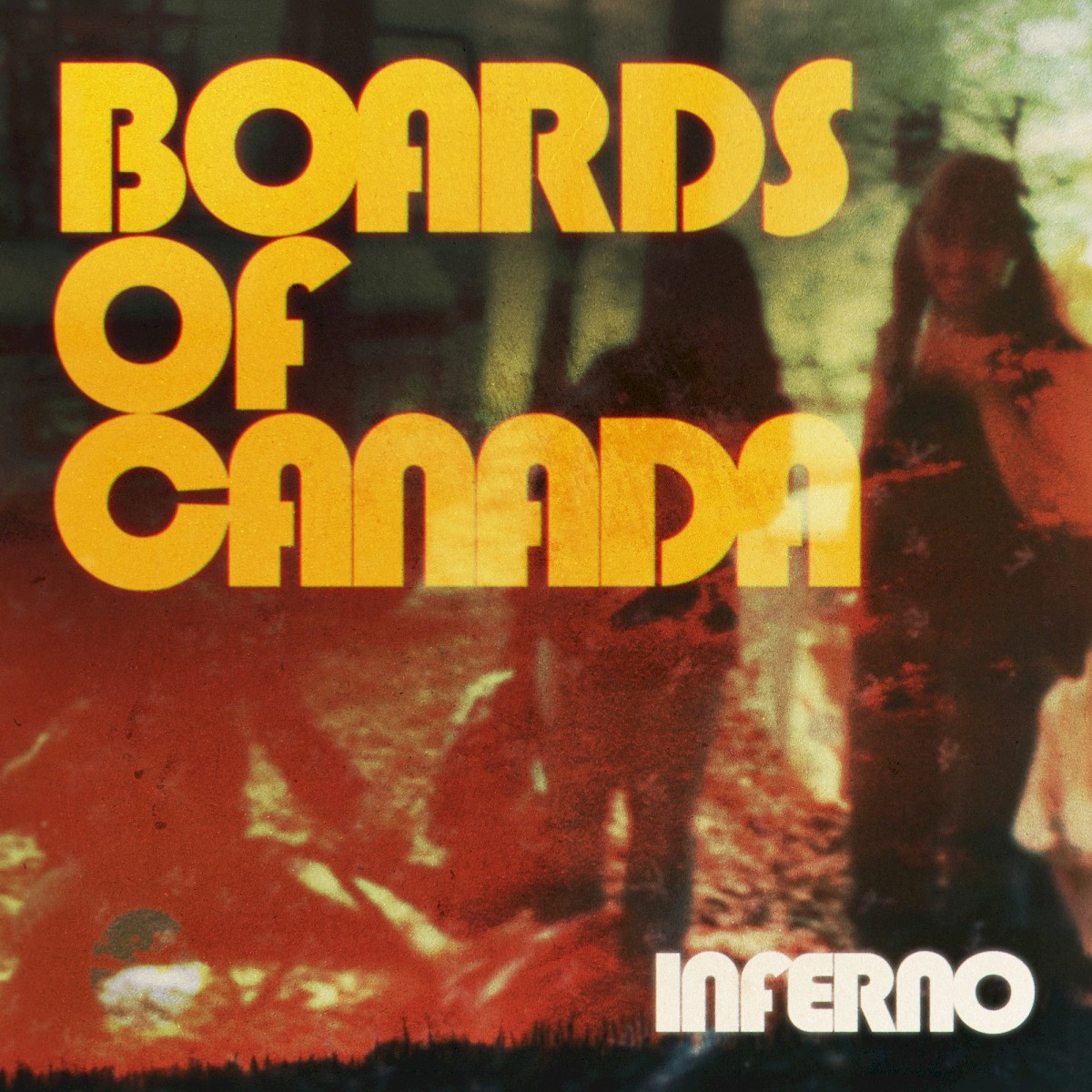
Inferno arrives under that pressure. A new Boards of Canada record is overinterpreted before it plays, because the group’s aura has taught listeners to treat each texture as clue, omen or relic. The album’s first task, then, is not to sound like Boards of Canada. It can hardly avoid doing that. Its task is to make that sound necessary again.
The notable thing about Inferno is that it does not attempt a theatrical reinvention. Anyone hoping for the duo to clear the room with a grand stylistic volte-face will be disappointed, though that disappointment may say more about the listener’s appetite for narrative than about the record. The palette is recognisable: soft-focus synthesiser figures, grainy low-end pulses, voices that surface as if from educational film stock or a half-remembered public information broadcast, melodies pitched between lullaby and warning. The old materials are present.
What has changed is the temperature. Earlier Boards of Canada often suggested distance: childhood seen through fogged glass, landscape observed after evacuation, dread held in a kind of formal suspension. Inferno, as its title threatens, brings the heat closer. Its best passages have a scorched intimacy. The bass does not merely throb in the background; it presses at the edges of the frame. The chords do not only decay; they seem to darken as they repeat. There is less of the pastoral here, less of that eerie open air in which a hill, a schoolroom and a nuclear warning could somehow occupy the same emotional space. The album feels more enclosed, more vertical, as though the old wide horizon had been replaced by a stairwell with something breathing below.
This is not a dramatic enlargement of the vocabulary, but it is a meaningful tightening of it. The music’s scale is often achieved through pressure rather than spread. Several pieces build not by adding new parts in the conventional sense, but by making existing ones feel heavier: a drum pattern acquires grit, a suspended chord develops a sour halo, a vocal fragment returns with slightly less human warmth than before. Boards of Canada have always understood that repetition is most unsettling when it appears to have changed without your permission. Inferno uses that trick with considerable discipline.
There is also a sterner structural instinct at work. The record resists the easy sequence of miniature, drift, beat-driven centrepiece, miniature, ominous finale. It still has interludes, if that is the word, but they are less like decorative smears between major statements than vents in the same structure. Brief passages of hum, crackle and choral blur do not interrupt the album’s argument; they alter the air pressure around it. This matters. A Boards of Canada record can easily become a cabinet of beautifully damaged objects. Inferno is more successful when it behaves like a single building with faulty wiring.
Familiarity is not the enemy of art. Mannerism is. The distinction is not always comfortable on Inferno, because the album repeatedly uses devices that have become inseparable from the group’s identity. The question is whether those devices are doing work or merely raising a flag.
The opening movement makes a good case for the defence. Its melody appears gradually, almost shyly, beneath a veil of hiss and low mechanical pulse. The tuning is unstable enough to suggest age, but not so exaggerated that one hears only “Boards of Canada effect, preset number one”. When a childlike vocal colour flickers at the edge of the mix, it is not foregrounded as an emblem of lost innocence. It is barely there, which is why it troubles the surface. The piece earns its unease through placement and proportion.
Later, though, the album does lean on inherited authority. There are moments when the degraded texture seems to arrive before the musical idea, as if the patina has been asked to carry what the melody has not quite supplied. A mid-album passage built around a slow, descending synth phrase and muffled percussive knock has all the correct ingredients: the fogged chord, the granular distortion, the drum sound like a locked door being tested from the other side. For a while it exerts the expected pull. Then one notices that the phrase itself is rather thin, and that the atmosphere is doing the emotional labour. The track does not fail, exactly. It succeeds too predictably. That is a different, more irritating problem.
The ominous drift fares better when it is allowed to become unstable. In one of the album’s strongest central stretches, a rhythm that initially seems bluntly functional begins to shed certainty: the kick lags by a hair, a brittle upper figure slips against the bar line, and a warm chord underneath starts to curdle. The effect is not shock but corrosion. What first reads as repetition becomes narrative. There is no need for a sudden crescendo or horror-film punctuation. Boards of Canada remain among the few electronic acts who can make a filter change feel like a moral event. I realise how absurd that sentence looks. I stand by it.
The weaker material is less patient. A few short pieces offer the familiar distant-choir wash, the antique electronic sigh, the sense of a transmission received from a room nobody should enter. They are handsome, but pre-solved. You know how to feel before they have argued for it. This is where the group’s command of surface threatens to become a form of politeness, giving the faithful listener exactly the kind of unease requested. One begins to miss risk, or at least inconvenience. Beauty can be a narcotic, and Boards of Canada have always had an excellent bedside manner.
After the necessary scepticism, a concession: the consensus survives because the music continues to do things few others manage with such restraint. Boards of Canada’s great subject has never been nostalgia in the simple sense. They are not sentimental archivists of a lost childhood, however often the shorthand says so. Their real gift is the contamination of tenderness by uncertainty. A phrase can be lovely and unsafe at the same time. A rhythm can soothe while suggesting that the system producing it is damaged. On Inferno, that doubleness remains alive.
The album’s most affecting passages refuse to clarify their emotional status. A softly glowing sequence near the record’s latter half might, in another context, register as consolation: rounded chords, slow harmonic movement, a melodic fragment with the contour of a lullaby. Yet the surrounding grain keeps pulling it away from comfort. The sound is warm, but the warmth feels environmental rather than human, like heat from a fire you did not light. That ambiguity is not an accessory. It is the point.
Their handling of voice remains particularly exact. Human sound in this music rarely behaves as a lyric-bearing presence. It is memory, signal, residue, sometimes accusation. On Inferno, the buried vocal fragments are used sparingly enough to avoid self-parody. When they appear, they complicate the instrumental world rather than decorating it. A syllable emerges, dissolves, returns in altered colour. One tries to identify it, then gives up, then keeps listening harder. That tiny drama of recognition and failure is central to the group’s power.
The record is also more emotionally varied than its title might suggest. There is dread, certainly, and a more claustrophobic dread than usual, but there are also pockets of weary grace. Some of the softer pieces carry a resignation that is neither defeatist nor grand. They do not present ruin as spectacle. They sit with it. This is where Inferno deepens the old language: not by inventing a new grammar, but by finding a harsher light in which the familiar grammar can be heard.
One should be careful here. Critics of my vintage can over-reward restraint, partly because we have been so thoroughly punished by its opposite. Still, the restraint on Inferno is not mere tastefulness. The duo understand how little needs to happen for a room to change. They trust the listener to hear small shifts in pressure, colour and decay. In a culture that often mistakes explanation for depth, that refusal has force.
Inferno is neither a radical renewal nor an exercise in empty self-repetition. It is a distillation with visible stress marks. At its best, it proves that Boards of Canada’s familiar devices still generate mystery because they are tied to compositional judgement: the withholding of resolution, the careful fouling of beauty, the placement of voices and textures at the edge of intelligibility. At its weakest, it shows how easily that same language can become a certificate of authenticity, stamped before the music has quite earned it.
That mixture makes the album more interesting than a clean triumph would have been, and less satisfying than the devoted may wish to claim. It asks the listener to attend to differences of degree: how much distortion is expressive, how much is branding; when repetition accrues meaning, when it merely circles; whether unease is being discovered or administered. These are small questions only if one thinks smallness is simple.
The received reading, then, is still broadly right, but it needs sharpening. Boards of Canada remain masters of decay, memory and unease, yet Inferno matters most when those terms stop functioning as compliments and become tests. The album passes often enough to command attention, and fails often enough to remind us that even a haunted house can have familiar wallpaper. Its grip holds not because the old aura surrounds it, but because, in its strongest moments, the music makes that aura audible again: flickering, damaged, tender, and not quite safe.