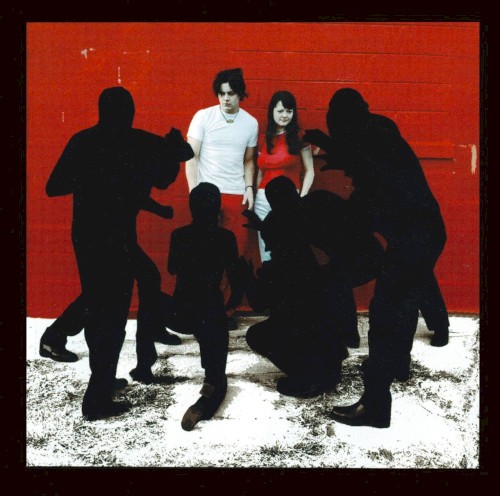
White Blood Cells appeared in 2001, at the moment when rock music had begun to suspect itself of redundancy. The late 1990s had been marked by either the bloated afterlife of alternative rock or by genres that preferred irony to risk. The White Stripes’ third album announced itself, therefore, not as a revolution but as a narrowing: a wilful reduction of means so severe that it bordered on parody. Two people, red and white, guitar and drums, no bass, no virtuosity. The gesture mattered as much as the sound. In the London Review of Books one might say that White Blood Cells is not so much an album as a proposition about how music might still mean something under conditions of cultural exhaustion.
Jack White has often been described as a primitivist, though the term obscures more than it reveals. Primitivism implies innocence or regression; White Blood Cells is neither innocent nor naïve. It is aggressively self-conscious. The opening track, ‘Dead Leaves and the Dirty Ground’, stages its own thesis: the guitar riff is skeletal, almost threadbare, but it is presented with the gravity of a manifesto. White’s voice is pitched between a shout and a sneer, as though he were arguing with the song even as he sings it. This tension—between assertion and doubt—runs through the album. The music insists on its own necessity while continually exposing how little there is to insist with.
The album’s sound is often described as raw, but rawness here is an aesthetic choice, not a lack. Meg White’s drumming, famously minimalist, does not so much keep time as underline absence. Her beats are blunt, repetitive, occasionally awkward, and crucially resistant to embellishment. They refuse the listener the comforts of groove or propulsion. Instead, they create a space in which Jack White’s guitar can behave less like an instrument of melody than like a tool for abrasion. On ‘Fell in Love with a Girl’, the album’s best-known track, the song barely lasts two minutes, yet feels over almost before it has properly begun. It is pop music reduced to a violent haiku: desire stated, enacted, abandoned.
What distinguishes White Blood Cells from mere revivalism is its unease with the past it draws on. The blues structures that surface throughout the record are not treated reverently; they are bent, compressed, sometimes caricatured. ‘The Union Forever’ borrows its melody from ‘Citizen Kane’, a reference that seems almost perversely literary for a band supposedly committed to simplicity. But the reference matters. Orson Welles’s film is about ambition, control, and the impossibility of total expression—subjects that haunt Jack White’s songwriting. Again and again, the album returns to images of confinement, repetition, and self-division. The title itself suggests both purity and pathology: white blood cells are agents of defence, but also signs of illness when they proliferate.
Lyrically, White oscillates between bravado and vulnerability, often within the same song. His narrators are prone to grand declarations that collapse under their own weight. ‘I’m finding it harder to be a gentleman,’ he sings on ‘I’m Finding It Harder to Be a Gentleman’, which is less a confession than a diagnosis. Masculinity, here, is not celebrated but scrutinised, revealed as a performance that demands constant reinforcement. The album’s fixation on colour—red, white, black—functions similarly. These are not symbols of purity or clarity but of restriction, a deliberately limited palette that forces meaning to emerge from repetition rather than expansion.
Listening to White Blood Cells now, more than two decades later, one is struck less by its influence than by its refusal to resolve its own contradictions. It does not point forward so much as inward, toward a problem it cannot solve: how to make something urgent out of almost nothing. The album’s answer is not reassuring. It suggests that urgency arises not from abundance but from pressure, from the friction between ambition and constraint. In that sense, White Blood Cells belongs less to the history of rock than to a longer, more anxious tradition of modern art, one that understands reduction not as a route to purity but as a way of exposing the nerves.
If the album still matters, it is because it does not offer redemption. It offers instead a disciplined kind of dissatisfaction. Like the best essays, it circles its subject obsessively, worrying at it, stripping it down, refusing to let it rest. What remains is not clarity but intensity—a reminder that meaning, when it appears at all, often does so under conditions of deliberate scarcity.