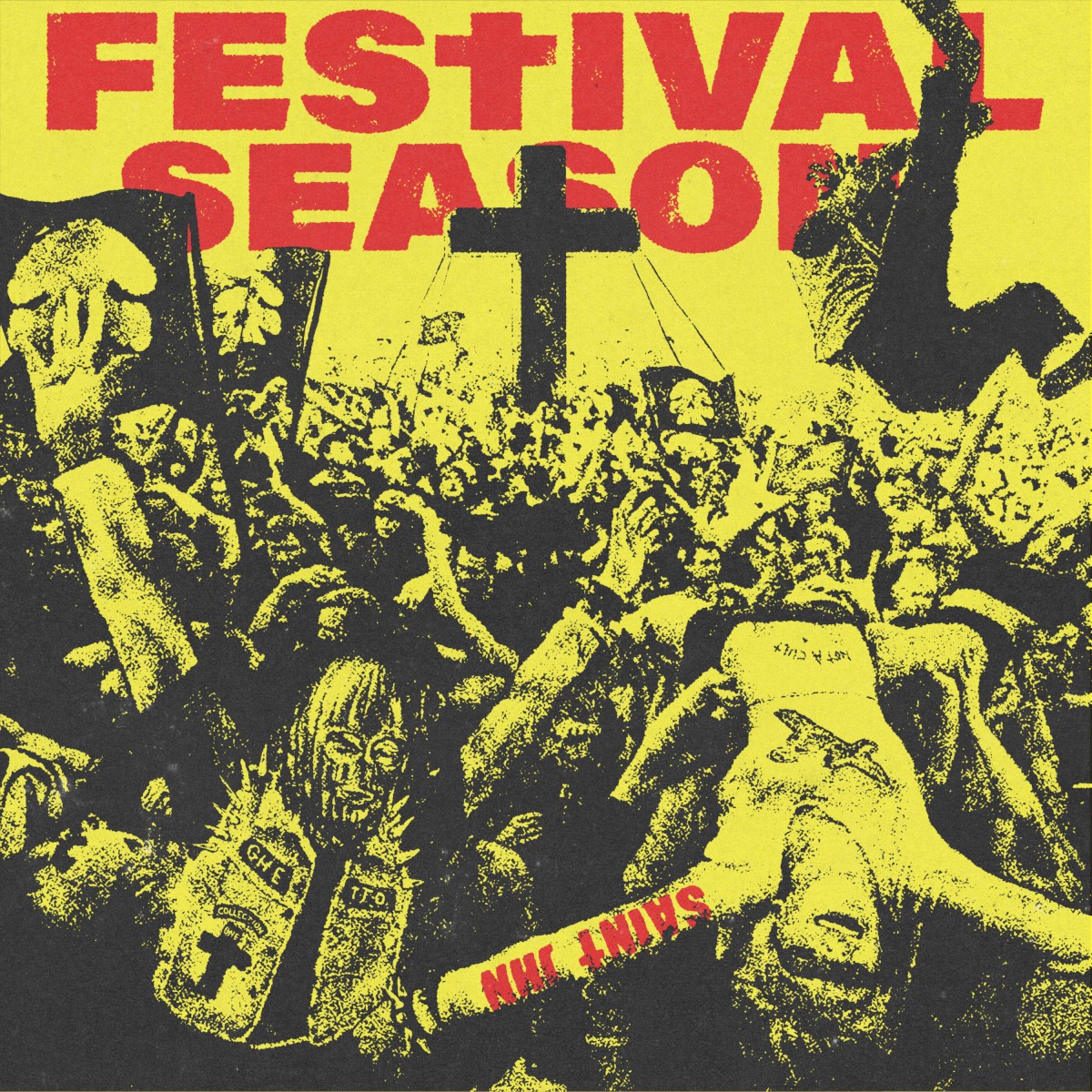
FESTIVAL SEASON is best taken as an instruction before it is taken as a mood. The phrase tells you where the record thinks it might live: not in the small hours of a bedsit, not quite in the car, not even solely in the club, but in that strange contemporary middle distance where pop, rap and dance music are expected to behave as weather systems. Big enough for the open air, clean enough for the playlist, emotive enough to look profound from the back of a field.
That is not a complaint. Records have jobs, and pretending otherwise is one of criticism’s more persistent vanities. A song designed to lift a crowd is not automatically less serious than one designed to document someone’s diary with an acoustic guitar and an expensive microphone. The question is whether FESTIVAL SEASON understands its function deeply enough for feeling to emerge from it, or whether it treats scale as a substitute for form.
SAINt JHN has always been interesting precisely because his centre of gravity is unstable. He is not simply a rapper who sings, or a singer with rap cadences, or a pop writer wearing trap drums as styling. His most persuasive work tends to occupy the blurred space where melody is delivery, production is architecture, and the vocal is less a confession than a signal moving through a system. On this album, the system is obvious: impact, lift, release. The more complicated matter is what remains when the fireworks are taken away.
The album’s sound is arranged around width. The beats leave enough space for the vocal to loom, with low-end pressure doing the physical work and bright synths or guitar figures supplying the horizon line. The percussion often moves with the clipped efficiency of contemporary trap, hi-hats ticking in the corners, kicks landing with more weight than swing. Around that, the writing keeps reaching for the kind of hook that can survive poor festival acoustics and worse phone footage. Short phrases, clean contours, emotional vowels. Useful things.
SAINt JHN’s voice remains the most distinctive instrument here: grainy, processed, pitched between bruised croon and melodic rap, usually treated so that intimacy and distance happen at once. Auto-Tune is not a mask in this setting. It is the surface on which the drama is written. When he stretches a syllable until it becomes almost synthetic, the effect is not dehumanising so much as public-facing. Private feeling has been rendered in a format that can travel.
The album’s pacing favours elevation over shock. Transitions are generally smooth, textures polished, drops less about surprise than confirmation. There is little interest in the unstable, sweat-soaked churn of club music proper. This is festival music in the post-streaming sense: built to imply the crowd rather than depend on one. It can sit in a gym playlist, a late-night drive, an outdoor stage at dusk, or the algorithmic nowhere where most pop now performs its social life. The record knows this, sometimes too well.
There are moments when the scale is convincing because the production keeps the centre clear. A skeletal drum pattern, a halo of synth, the vocal pushed forward until the hook feels inevitable. Elsewhere, the same technique hardens into gloss. The mix becomes large without becoming particular, and the songs start to feel engineered for a generalised aerial shot: hands up, lights on, feeling unspecified.
The emotional language of FESTIVAL SEASON is familiar: desire, injury, success, isolation, the peculiar loneliness that comes dressed as luxury. SAINt JHN does not usually argue these states into being through narrative detail. He stages them as atmosphere. That can be a strength. Rap-pop often gets misread when critics go looking for the wrong evidence, as though emotional seriousness must announce itself through diaristic precision. Here, meaning more often sits in the friction between the vocal’s ache and the track’s public machinery.
At its best, the album makes that friction legible. The festival setting becomes a useful contradiction: a record about being exposed and unreachable at the same time. SAINt JHN’s persona is built for this paradox. He sounds expensive and wounded, self-mythologising and slightly stranded inside the myth. The hooks open outward, but the vocal texture keeps dragging them back towards the body. You can hear why this music wants a crowd, and also why the crowd would not solve anything.
The weaker passages treat uplift as a preset. A big chorus arrives because the arrangement has cleared room for one, not because the song has earned the ascent. Melancholy becomes a colour grade. Triumph becomes another form of reverb. This is the risk of music so fluent in its own crossover grammar: it can produce the signs of feeling faster than it can locate the feeling itself.
Still, the functional design does deepen him in places. The repetition, the spaciousness, the melodic insistence, these are not empty by default. Repetition is how crowds learn to believe a song, and how a private phrase becomes communal property. The album understands that. What it does not always do is decide which phrases deserve that treatment.
The borrowed machinery of scale
The record’s ambitions are inseparable from Black musical lineages that pop routinely absorbs and then describes as ambience. The melodic trap vocabulary is obvious: 808 weight, triplet-adjacent flows, sing-rap phrasing, drums that leave negative space for personality rather than filling every bar with display. There is also the long R&B inheritance of the voice as both seduction and wound, especially in the way SAINt JHN lets timbre carry what the writing leaves unsaid.

Auto-Tune, too, should be understood as part of a Black pop and rap continuum, not as a cheap futurist lacquer. From gospel melisma to talkbox funk to T-Pain’s radical formal clarity and the post-808s & Heartbreak mainstream, the altered voice has often been a way of making emotional excess sound newly precise. SAINt JHN works inside that history with real fluency. He knows how to make processing feel like pressure rather than decoration.
The album also leans towards the festival economy of dance music, though more through gesture than through actual club discipline. Builds, suspended pads, chant-ready hooks, bass drops that imply release rather than risk: these are the tools of electronic spectacle, repurposed through rap-pop songwriting. His earlier crossover visibility through the remix culture around “Roses” remains relevant here, not as trivia but as a clue. SAINt JHN’s pop life has been shaped by the dancefloor’s ability to mutate a song’s meaning through function. FESTIVAL SEASON sounds aware of that lesson, even when it prefers the grand stage to the room.
There are also traces of Caribbean and diasporic pop logic in the album’s ease with bounce, compression and melodic repetition, though it rarely foregrounds them. The borrowing is not crude. It is more like inherited grammar, sometimes purposeful, sometimes blurred into the general language of global pop. The danger is vagueness. When every lineage is smoothed into a festival-ready sheen, the record risks sounding less borderless than decontextualised.
FESTIVAL SEASON succeeds most clearly as a record of application. It knows how to occupy space. It knows what a hook is for. It understands that atmosphere is not the absence of meaning, but one of the ways pop distributes meaning at scale. SAINt JHN remains compelling because he can make polish feel bruised, and because his voice carries a small weather system of its own even when the writing thins out around it.
The album is less persuasive when festival readiness becomes its whole argument. A crowd can magnify feeling, but it cannot invent specificity on the artist’s behalf. Some of these songs seem to imagine the aerial shot before they have found the room, the face, the detail, the small ugliness that would make the grandeur bite. They are impressive in the way a lighting rig is impressive: expensive, functional, briefly overwhelming, then packed away by people in black T-shirts.
What survives when the spectacle is stripped back is not a hidden confessional masterpiece, and the album is better for not pretending otherwise. What survives is a voice, a set of melodic instincts, and a smart understanding of how rap, R&B and dance-derived pop now circulate through public life. FESTIVAL SEASON is not empty spectacle. Nor does it fully escape the flattening effect of designing everything for the largest possible surface. Its best moments find feeling inside the function. Its weaker ones mistake the function for feeling.