The reflex is old and still weirdly hard to kill: mess reads as courage, polish as evasion. A band leaves the seams showing and we call it risk. A band files the seams down and we start looking for the panic room. Vampire Weekend have always been especially vulnerable to this kind of moral accounting, partly because their surfaces are so legible, so pleased with their own intelligence, so clean you can see the anxiety reflected back at you.
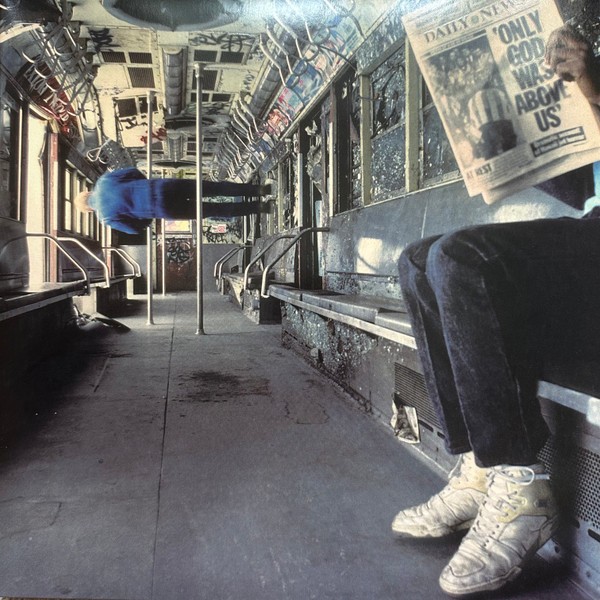
Only God Was Above Us is too dense, too harried, too full of alarms to be mistaken for a retreat into good taste. Its refinement is not a cop-out. It is the mechanism by which the record makes overload audible. The album does not answer chaos by pretending to fall apart. It arranges the pile-up, tightens the frame, lets piano, strings, drums, choir-like voices, saxophone blurts and lyrical fragments compete inside songs that still know where they are going. The danger here is not in collapse. It is in control held for one bar longer than feels comfortable.
Vampire Weekend records tend to arrive with explanatory scaffolding already attached. There is always a story available: class, taste, New York, cleverness, cosmopolitan appetite, the burden of having been called preppy so many times that the word now feels less like criticism than a dead browser tab. More recently, there is the streaming-age version of that story, where every new song appears not only as sound but as a prompt: Is this a return? Are they correcting course? Are we allowed to like something this arranged without laundering it through irony?
Those stories are not irrelevant. They affect the room in which the record is heard. They are also a poor substitute for listening. Only God Was Above Us does not need the listener to solve Vampire Weekend as a cultural problem before the songs can work. The album’s force is local and audible: the clipped entrances, the sudden thickening of arrangements, the way a melody that first looks decorative becomes another pressure point. The mythology may get you to the door. The writing and pacing decide whether you stay.
The album’s density is engineered rather than spilled. That distinction matters. A lesser version of this record would have equated urban psychic overload with random collision: more distortion, more shouting, more objects thrown into the mix for the sake of proving the room is crowded. Vampire Weekend choose a stranger and, to my ear, stronger method. They make the songs feel overpopulated while keeping the routes through them precise.
“Ice Cream Piano” is the opening argument in miniature. It begins with a poised, almost suspiciously elegant piano figure, the sort of thing that could be accused of tasteful distance if the song did not keep mutating around it. The track gathers force through arrangement rather than looseness: drums shove forward, voices stack up, strings and guitars crowd the upper register, and the whole thing starts to feel like a beautiful room whose walls have moved inward. The clarity of the mix does not ease the claustrophobia. It sharpens it. Every element has a hard edge, which means there is nowhere for the ear to blur out and hide.
Ezra Koenig’s writing on the album works in a similar way. The lyrics often arrive as compressed civic and private debris: old institutions, generational unease, moneyed interiors, spiritual fatigue, jokes that sour quickly. He does not sing like a diarist confessing over four chords, and thank God, because the culture has enough expensive vulnerability cosplay. He sings as if consciousness itself has been tabbed to death. A phrase flashes up, is replaced by another, then returns altered by the arrangement around it. This is how the record evokes the city without leaning on postcard realism. It gives you simultaneity.
The rhythm section is crucial to that simultaneity. These songs often move with a fidgety, almost over-caffeinated propulsion, but the drums rarely sound sloppy or wild in the approved rockist way. They are busy, clipped, tucked into pockets that keep shifting beneath Koenig’s melodies. Piano is everywhere, sometimes stately, sometimes percussive, sometimes behaving like another piece of street machinery. The arrangements leave space, then fill it too quickly. You can hear the vacancy and the intrusion in the same gesture.
“Classical” is the clearest test of the anti-polish thesis, because on paper it has all the ingredients that could make sceptics reach for the word “fussy”: bright piano, nimble percussion, a sharply contoured hook, horns that seem to enter with comic timing. Yet the track does not smooth its subject. Its precision gives the song a brittle, almost administrative cruelty. The instrumental breaks feel less like release than interruption, as if the song keeps being cross-examined by its own arrangement. The beat has bounce, but not comfort. The polish makes the unease legible.
“Capricorn” moves differently. It is one of the album’s most immediately graceful songs, built around a worn, circling melancholy that could easily have gone soft. Instead, the production scuffs the elegance from within: piano tones blur at the edges, the low end has a drag to it, and the chorus opens out without pretending to resolve anything. The song’s beauty is not consoling. It has the exhausted glow of someone checking their phone at 3am and finding only more evidence. Too online? Fine. But the feeling is there in the arrangement: connection without relief.
“Connect” is where the album’s method becomes almost comically literal, in the best way. It is all joins, hinges and sudden reroutings, piano figures darting in and out, sections snapping into place before the listener has quite settled into the last one. The song has movement without the fantasy of clean progress. Its complexity is not ornamental sophistication, although Vampire Weekend remain very good at ornament. It dramatises the act of trying to assemble a coherent path through competing signals. A messier version might have sounded more spontaneous. This one sounds more trapped.
Then there is “Gen-X Cops”, a title that practically begs to be treated as a meme before it has played a note. The song itself is more interesting than the bait. Its guitars have a serrated, siren-like insistence, and the vocal line rides the track with a clipped impatience that makes nostalgia feel unusable. The arrangement is taut enough to make the abrasions count. Distortion here does not function as a credibility sticker. It is one texture among many, deployed for pressure rather than proof.
“Mary Boone” is the album’s grandest balancing act. The beat has a hip-hop weight, the choral elements lift the song into something almost ceremonial, and the piano grounds it in a recognisably Vampire Weekend fluency. It could have tipped into museum-piece splendour. Instead, the scale feels implicated in the song’s anxieties about art, ambition and the rooms where value gets decided. The track is lush, yes, but lushness is part of its argument. It understands that systems of taste often announce themselves beautifully.

Not everything lands with the same force. “The Surfer” drifts so knowingly that its haze can feel designed rather than discovered, and “Prep-School Gangsters”, despite its melodic charm, is a little too comfortable in its slantwise character sketch. The album’s refinement occasionally tempts the listener to admire the joinery when the house is meant to be burning. Still, those moments are exceptions to the larger success. Even the long closer, “Hope”, which risks wearing out its repeated plea, gains power through patience. Its polish becomes attritional. The song does not explode; it persists until release starts to sound like discipline.
The easy framing is to call Only God Was Above Us a return, especially if one wants Vampire Weekend to stand still long enough to be loved cleanly. The word is seductive because the album restores certain pleasures associated with the band: compact melodic intelligence, quick arrangements, New York pressure, Koenig’s knack for making the urbane feel faintly cursed. But “return” is lazy if it implies restoration of an earlier innocence. There was no innocence to restore, and the record is too crowded with present-tense fatigue to behave like a reboot.
Nor is it convincing to hear the album as a self-correction after the looser sprawl of Father of the Bride. That reading flatters critics more than the band. It imagines a neat course adjustment, as though Vampire Weekend had wandered into excess and have now dutifully come back to the seminar room with sharper notes. Only God Was Above Us is not smaller in ambition. It is more compressed. Its discipline is a new way of organising clutter, not an apology for having once let more air in.
This matters because revival narratives often smuggle in bad listening habits. They reward recognisable gestures over transformed ones. Here, the familiar Vampire Weekend signatures are pushed towards a harsher density. The crispness is still there, but it no longer reads as lightness. The cleverness is still there, but it feels less like display than self-defence. The album’s real achievement is making those old tools register as newly pressurised.
Placed within Vampire Weekend’s catalogue, Only God Was Above Us is closest in spirit to the moments when the band’s elegance has carried dread rather than escaped it. It has the concision of their early work without its spring-loaded innocence, and the grander reach of their later records without quite the same looseness. The result is not their messiest album, nor their most immediately charming. It may be their most architecturally tense.
That will not satisfy listeners who still want risk to announce itself through visible damage. Fair enough, sometimes damage is the sound. But on Only God Was Above Us, Vampire Weekend make a persuasive case that form can be a record of strain rather than a denial of it. The album’s polish is not a cosmetic screen laid over disorder. It is how the disorder is measured, intensified and made strange enough to hear again.