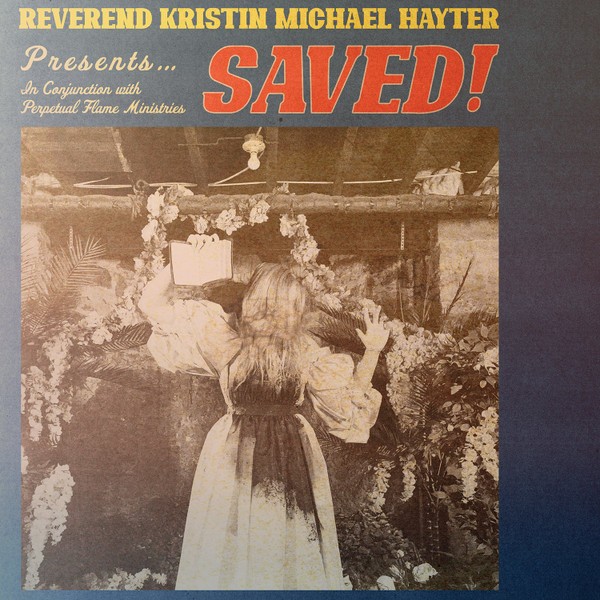
Saved! works because it refuses the easy reading that has followed Kristin Michael Hayter for years. The lazy version says: here is an artist known for extremity, now draping herself in Christian language for one more confrontation. The more interesting truth is harder to package. This record takes devotional music seriously enough to find out where its forms break under pressure. Its hymnal plainness, its prayerful pacing, its almost punishing austerity are not camouflage for shock. They are the experiment.
That experiment is often gripping. It is also occasionally so severe in its self-denial that it risks flattening its own drama. But when Saved! locks into its central tension, the result is remarkable: a record that asks whether redemption can be sung directly, in clean lines and familiar cadences, or whether for this artist it only arrives as something strained, theatrical, half-wrestled into being. Hayter has made an album whose devotional surface keeps touching, and then scraping against, the violence of feeling beneath it. You hear belief, performance, discipline and damage in the same breath. Few records this year are as committed to their own premise.
Musically, Saved! is sparse in a way that feels less minimal than disciplinary. The arrangements tend towards church-adjacent basics: piano, organ-like sustain, hymn structures, melodies that move with the grave certainty of liturgy. Hayter does not decorate these songs much. She narrows them. The effect is not cosy reverence, nor camp desecration. It is closer to being shut in a room with devotional forms until every small inflection starts to matter.
That means the voice carries an enormous share of the record’s force, and Hayter knows it. She sings with clarity more often than some listeners may expect, but she never settles into the smoothing function that “clarity” usually implies in religious music. Her phrasing keeps testing the line between testimony and ordeal. A held note can sound like surrender one second and accusation the next. On a weaker album, this would scan as mannerism. Here it becomes the whole argument. These songs ask what happens when the voice is meant to model grace but cannot stop revealing stress.
Repetition is crucial. Saved! leans on the repetitive mechanics of worship music and hymnody, where musical recurrence is meant to stabilise feeling and guide the body towards assent. Hayter uses the same mechanism, but she leaves enough abrasion in the delivery that repetition does not simply soothe. It drills. A refrain can gather conviction through insistence, but it can also start to feel cornered, as if saying the words again will either sanctify them or expose that they are being asked to do too much. That uncertainty gives the record its pulse.
The pacing helps. There are no cheap jump scares, no gotcha ruptures thrown in to reassure listeners that they are still in the presence of a transgressive artist. Saved! understands that devotional music gets a lot of its power from duration, from asking you to remain with a phrase, a chord, a petition beyond your comfort. So the album often withholds eruption rather than chasing it. When intensity does rise, it matters because Hayter has built an environment of restraint around it. She stages pressure, rather than simply releasing it.
This is where the album’s theatricality comes into focus, and “theatrical” should not be mistaken for false. Christian music is full of staging, ritual staging, emotional staging, the choreography of humility and exaltation. Saved! hears that rather than pretending devotion arrives untouched by performance. Hayter inhabits these forms sincerely enough to let their theatrical dimension become visible. The record’s power comes from all of it at once: sincerity, friction, ritual, a voice that can sound as if it is pleading with heaven while also showing you the strain in the kneeling.
There are moments where the severity threatens to become monochrome. Deliberate austerity can be a great solvent for cliché, but it can also leave a song stranded if there is not enough melodic or emotional movement underneath. Saved! is strongest when plainness turns volatile, when a familiar sacred contour is allowed to carry too much psychic weight. When it simply stays pious in outline without finding that extra pressure point, the music can feel studied. Even then, the study is rigorous rather than decorative. Hayter is not borrowing church music as spooky set design. She is working inside its grammar.
It is impossible to hear Saved! without hearing the shadow of Hayter’s earlier work, and the album knows that. But treating it as a straightforward pivot, from one project to another, from profane extremity to sacred order, misses what is actually happening. The continuity is less in sound than in method. Hayter has long been interested in performance as a site where unbearable feeling gets formalised. Saved! carries that concern into devotional music and asks whether Christian forms can contain such feeling without collapsing into melodrama or self-parody.
That places the album in a curious and fertile space between traditions. It draws on Christian musical language, hymn forms, revivalist plainness, sacred recital discipline. It also belongs to a lineage of experimental composition that uses reduction and repetition to alter how listening works. And then there is the older history of spiritually charged performance, where the voice is never just delivering a song but enacting a trial, a surrender, a possession, a testimony. Saved! does not sit neatly in any one of these streams. It rubs them together.
That matters because so much current discourse still wants a clean story. If an artist engages with Christian material, online reaction tends to swing between two thin readings: total sincerity, treated as confession, or arch provocation, treated as trolling with a hymn book. Saved! frustrates both, which is part of why it has such force. It inhabits devotional form too carefully to be dismissed as an aesthetic prank. Yet it also keeps enough tension in the music that simple declarations of faith do not explain the experience of hearing it. The album sounds like someone testing whether sacred language can bear the full charge of her voice, and whether that language gives anything back besides structure.
There is a wider context here too, one the album quietly exposes. Music now moves through feeds that flatten strong formal decisions into content categories. Religious signifiers get clipped into discourse before the songs have had time to work. Extreme music gets reduced to affect, devotional music to messaging. Saved! resists that sorting because its whole achievement lies in structure and duration, in how long it makes you sit with unresolved relation between discipline and breakdown. It will probably be consumed, in some corners, as an image problem or a discourse object. That is a pity, and also predictable. The record itself is smarter than the rollout chatter that tends to gather round any artist with Hayter’s history.
More to the point, Saved! refuses the stale idea that underground seriousness has to announce itself through abrasion alone. There is real boldness in how controlled this album is. Younger artists across experimental and fringe songwriting have been moving this way for a while, toward precision, arrangement, and inherited forms used with intent rather than ironic distance. Hayter is doing something adjacent, though far more severe. She is not “going traditional” in any cosy sense. She is stress-testing tradition from within.
Saved! lands as a demanding and often very moving piece of work because it never lets the listener off with an obvious answer. If you come to it wanting a scandal, the record is too disciplined. If you come wanting uncomplicated worship, it is too unsettled. What it offers instead is a study of devotional form under pressure, one that treats Christian musical language as a living structure with its own emotional technologies, not a stockpile of charged symbols to nick for atmosphere.
That will challenge plenty of listeners. Some will hear the intensity and decide the theatricality invalidates the devotion. Others will hear the devotional seriousness and wish Hayter had pushed harder towards rupture. Both reactions miss the point a bit. The album’s best passages live in the impossible overlap, where ritual feeling and performative excess become indistinguishable. Hayter understands that singing salvation has always involved staging the self before an audience, whether that audience is a congregation, a camera, God, or your own breaking mind.
As criticism-worthy art, Saved! matters because it does not just deploy religious form, it interrogates the conditions under which that form means anything. Can a hymn hold panic. Can repetition produce grace rather than numbness. Can sincerity survive self-consciousness. Hayter does not solve those questions, and thankfully she does not package them into a redemption arc for easy consumption. She lets the songs remain difficult, bare, strangely formal, then suddenly raw in a way that feels earned rather than advertised.
The lasting impression is not one of blasphemy or conversion. It is of pressure. Pressure inside the voice, inside the ritual, inside the old promise that music can deliver a person somewhere cleaner than they began. Saved! keeps pressing on that promise until it glows and buckles at once. Even when the album is severe to the point of frustration, it is alive in its inquiry. And when it hits, it feels less like witnessing a reinvention than watching an artist find the exact form her contradictions require.